Home > > Company News
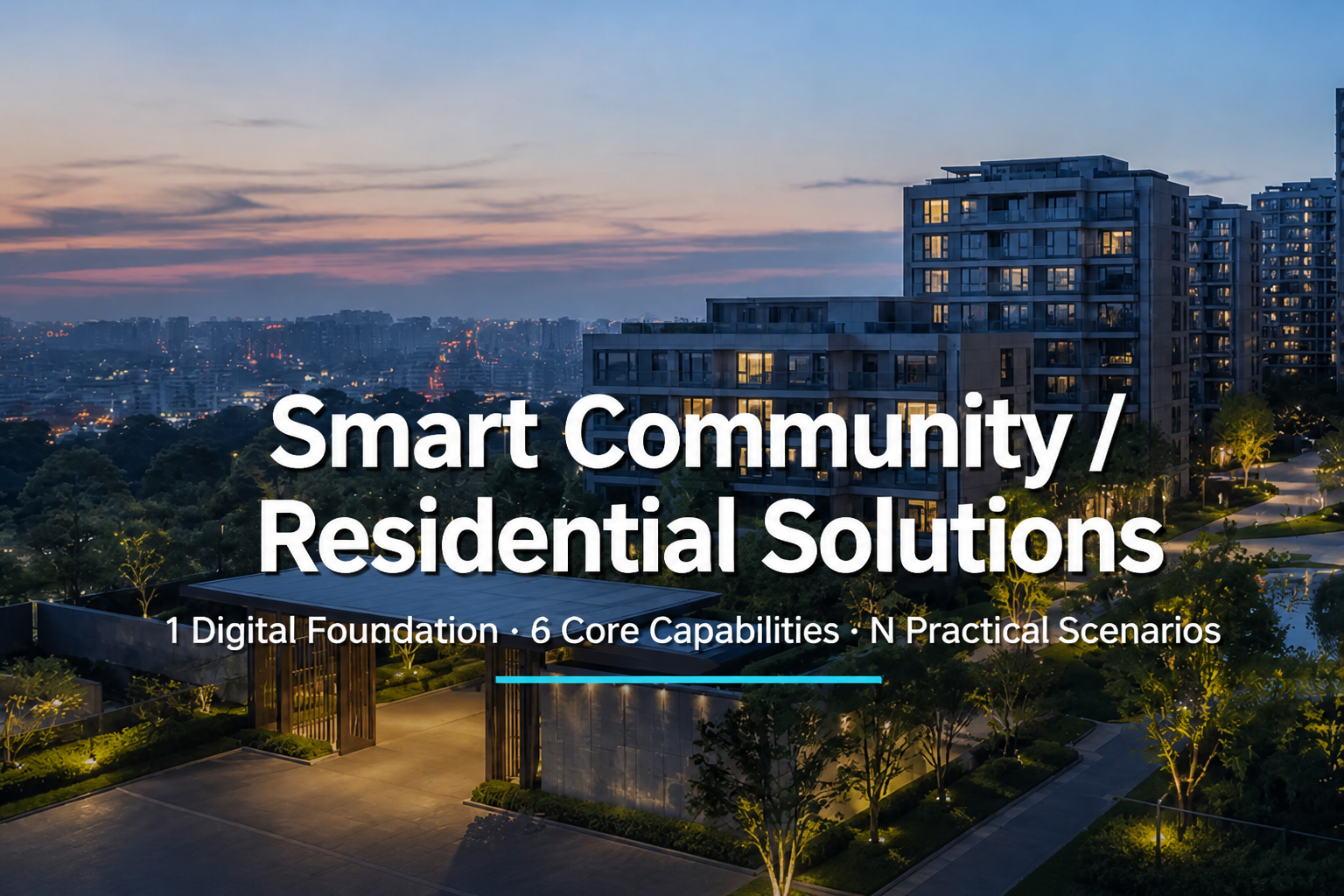
The solution rests on six core capabilities — AI access, lift control and visitor passage; autonomous robot access and lift control; smart car park management; full-domain smart security with AI inspection; smart home integration; and smart property services — bringing together video intercom, face recognition, CCTV, lift control and smart parking as one product set.
Above those capabilities sit five categories of business outcome: frictionless passage for people and vehicles, autonomous robot inspection and autonomous elevator riding, AI risk detection and early warning, whole-home device linkage, and online property fee payment with community operations management.
Operationally, the system runs on data. Passage, work orders, payments and security events aggregate into a single back-end, letting the property team judge equipment health, work order turnaround and fee collection progress. For developers, these capabilities are part of the product itself, supporting price premium and sales velocity. For property managers, they lower long-run operating cost, lift collection rates, and keep shaping the community brand after handover.
Carries four responsibilities:
Every door, barrier, lift controller, charging pile, camera and robot connects through one interface. Identities and permissions for the four passage subjects — people, vehicles, visitors and robots — are administered in a single place.
Covering four passage subject types (people, vehicles, robots, visitors), security inspection, in-home living, and property operations.
Because all six share one foundation, adding a new capability means adding a module — never rebuilding the account, permission and billing systems from scratch.
Frictionless pedestrian passage, frictionless vehicle passage, robot delivery and inspection, charging services, online property fee collection, and community value-added services.
Scenarios can be switched on phase by phase. The foundation never changes.
Eight capability blocks, each described by what it does, and what it is actually worth to the developer and the property team.
The pedestrian entrance is the community's first line of security and the touchpoint owners feel most often. This capability puts face recognition at the core and layers it with remote door opening, visitor invitation and lift linkage, covering three passage identities: owners, family members and visitors.
After one face enrolment, owners move through the gate without a card or a phone in hand — recognition passes and the barrier releases. Throughput at peak hours improves noticeably, and the cost of producing, issuing and replacing physical cards disappears.
When family visits unexpectedly, when cleaners or a nurse need access, or when a parcel must reach the door, the owner opens the door from a phone — no need to walk down, and no phone call to the gatehouse.
The owner submits visitor details and a time window; the system issues a pass credential. Visitors move through unaided within the validity period, and the pass expires automatically afterwards — so long-lived temporary cards stop circulating inside the community.
Pedestrian authorisation links the turnstile, the unit door and the lift. After passing the gate the lift is called automatically; inside the car no button press is needed. People and lifts arrive together, thinning the queues at entrances and lift lobbies.
When a visitor calls at the unit entrance, the call can be forwarded to the in-home control panel, where the owner completes a video call and opens the door remotely — no need to walk to the door or pick up the phone app.
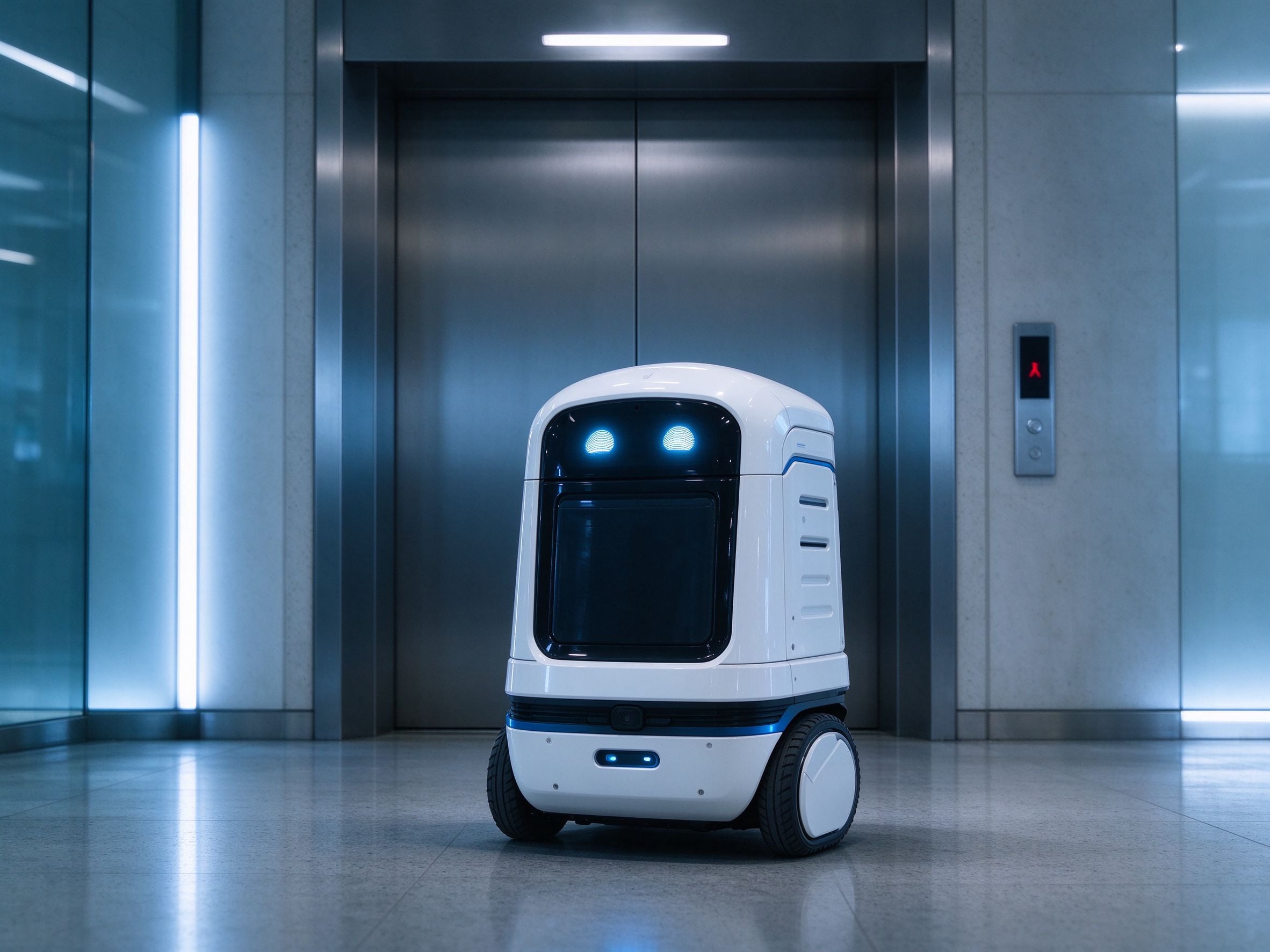
Delivery and inspection robots are rarely blocked by the site roads. The real chokepoint is the door and the lift. A robot that only moves at ground level still hands the last hundred metres to a human, which limits the gain. This capability therefore gives robots their own passage chain.
Once a robot completes identity and authorisation, the system issues the open command automatically at each door point — no one has to press a button. Unauthorised points stay locked, so a robot can never quietly extend its operating range.
At the lift lobby the robot calls the elevator automatically, selects its target floor on board, and supports multi-lift dispatch. Cars can be allocated by live status, cutting waiting time in the lobby and avoiding competition with owners for the same car.
Allowed zones can be planned per robot, with restricted access to plant rooms, children's play areas and fire routes. Permissions shift with the task type, so delivery and inspection can follow different passage policies.
Card read failures, unavailable lifts and authentication errors raise alarms and are pushed to the property team. A robot never idles long in a corridor or lobby and cause congestion, and the fault is located quickly.
Vehicle entrance throughput and billing accuracy affect owner experience and property revenue at the same time. This capability is built on plate recognition, with recognition, charging and cloud management kept inside one system.
The solution states a 99% plate recognition rate and applies AI correction of visually similar characters, cutting misreads caused by look-alike glyphs. For vehicles without plates, damaged plates or temporary vehicles, a QR code lane keeps the entrance clear. In normal conditions the barrier lifts on its own.
Twenty-four billing templates are built in, covering monthly permits, packages and temporary parking, adaptable to residential, retail and event scenarios. Parking and charging bills are linked and settled under one rule set, so no second invoice is produced.
Available spaces update in real time and multiple car parks can be managed from one cloud console. Entry and exit records, exception releases and free periods are all queryable, which removes repetitive gatehouse work and redirects staff to patrol and service.
As e-bike and EV ownership climbs, charging facilities are both a community amenity and a fire-safety and daily-operations concern. Rather than delivering charging as standalone hardware, the solution brings charging devices into the unified platform.
National-standard EV charging piles and e-bike charging piles, scan and go. Pole-mounted and wall-mounted formats adapt to surface parking bays, underground car parks and centralised charging shelters.
Overload, short-circuit, leakage and lightning protection with automatic cut-off on fault, preventing power from continuing to flow in an abnormal state. For centralised e-bike charging, this layer is the precondition for replacing private extension leads.
Device status, alarms, charging orders and fee settlement are managed together in the cloud, with remote fault diagnosis. Offline devices, communication faults and protection events are pushed proactively, so maintenance no longer depends on on-site inspection.
Traditional security depends on people watching screens and reviewing footage afterwards. AI moves “seeing” forward to “warning”, turning passive lookup into active push.
High-altitude object throwing, fire and smoke, and perimeter intrusion are recognised and pushed as alarms immediately, with the event recorded. High-altitude throwing is the hardest case: the difficulty is not detection but traceability — the alert must pin down building, floor and minute so that follow-up and liability determination hold up, which means alerts and video records must be retained together.
The security patrol robot runs a 24-hour autonomous route, covering the paths fixed cameras cannot reach and the night shift in particular. It follows a planned route and captures images at points on demand, complementing fixed coverage.
Fixed cameras, mobile patrol and platform alarms join one security network, with alerts converging in a single back-end — avoiding the scattered management of “many screens, many systems”.
Once an alert is confirmed it becomes a dispatch task assigned to the right role, and the handling process and outcome are recorded for review and assessment.
The value of community smartification only becomes real inside the home, where owners can feel it. This capability connects video intercom, lift control and the in-home control panel, so public-area access and home living run on one authorisation.
A visitor calls at the unit entrance; picture and audio are forwarded to the in-home panel, where the owner confirms identity and opens the door remotely.
Once authorised by the owner, a visitor calls the lift to the home floor, and the owner opens the door with a single tap. The visitor never re-registers and never waits for an escort.
Devices across the home connect to one control panel and can be linked by scene, reducing the cost of switching between several different apps.
Multiple smart home ecosystems are supported. During selection, the protocol types and access list should be fixed explicitly — otherwise owner-purchased devices land outside the system after handover and create a new island of disconnected hardware.
Half of the owner experience lives on a phone; half of the property team's efficiency lives in the back office. Notifications, work orders, visitors, value-added services and operational data converge in a single property workbench.
Notices, event announcements and emergency plans reach owners precisely through app, mini program and official account. One send, measurable reach — cutting the cost of posting notices and knocking on doors.
Owner-submitted repairs and complaints generate a work order automatically and dispatch by type. Progress is trackable and completed orders are archived and closed. The same data becomes the basis for performance assessment of response time and quality.
Domestic services, group buying and visitor services can be introduced on top of the existing owner base, opening new revenue paths without building a separate channel.
Owners generate a temporary visitor QR code online; visitors pass on the code alone. Visitor details and arrival records are retained automatically, relieving the front desk of manual registration.
Passage, work order, payment and security data are aggregated and visualised, giving the property team the basis for staffing, equipment maintenance and fee collection decisions.
Collection rate determines the property company's cash flow and its capacity to invest in service. Three factors decide it: whether payment is convenient, whether the bill is clear, and whether reminders arrive on time.
Property fees, parking fees, shared utility costs and repair charges are delivered as one bill, so the owner sees everything due at once instead of missing items scattered across several places.
Electronic bills are generated and pushed automatically, with payment supported across multiple channels. The payment entry and the bill sit in the same place, which shortens the path to payment.
Notifications go out before and after the due date, with the reminder cadence configurable per project — removing much of the manual phone-by-phone collection workload.
Payment records are retained long term and remain queryable and downloadable by owners, so fee disputes have a documented basis.
Permission behaviour under arrears can be configured — for example restricting visitor pass issuance or parking rights. Such measures touch owner rights, so the notice wording and the restoration conditions should be agreed before go-live to avoid disputes.
Visual collection statistics by building and by fee type, with one-click export of reconciliation statements for finance, cutting manual aggregation.
Four outcomes the system is designed to produce, stated for both sides of the delivery.
Smart capability forms part of what the product actually is. For developments in comparable locations with similar unit types, the difference in passage experience, home linkage and service efficiency directly affects how customers compare — and how much they accept. What this solution offers is capability a customer can experience on the spot, not a line on a specification sheet.
The demonstration area and the delivery standard stay consistent. The passage, visitor, car park and home scenarios shown during viewing are supported by the same system after handover, which reduces the trust cost of “showroom and delivery are two different things”.
Unattended car parks, centralised cloud management of devices, work orders moving online and bills generated automatically together remove recurring manual effort. Unified device access also lowers the cost of duplicating systems when the estate expands later.
A consistent passage experience and visible operational data form a service standard owners can feel. For developers this is the source of post-handover reputation; for property companies it is the basis for contract renewal and value-added services.
Four commitments that decide whether the system works after handover, not on day one.
The three areas the property team uses every day, and where operational data accumulates first.
These two modules carry higher demands on network, power and maintenance response, so they are recommended once the base capabilities are stable.
Effects depend on the passage, work order and payment data accumulated through the first two phases.
The contract should specify verifiable, extractable indicators — and define exactly how each one is measured. The table below is a starting set.
A named system owner must be appointed on the property side after delivery, with a retained remote maintenance channel and a route for receiving alarms, so that offline devices and communication faults are found at the first opportunity rather than at the next owner complaint.
Our professional sales team are waiting for your consultation.
 EN